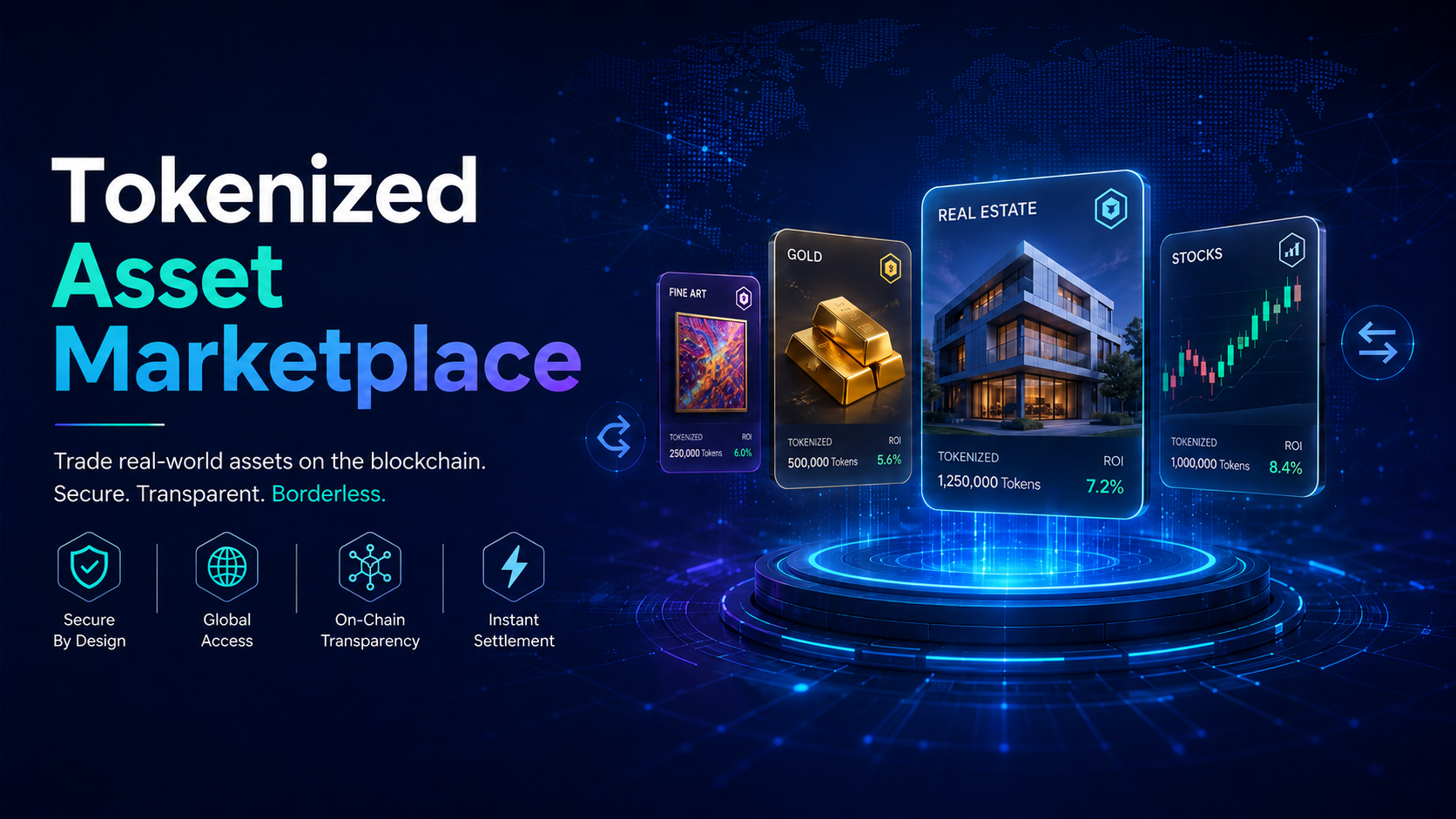
A tokenized asset marketplace is becoming one of the most important pillars of modern digital finance. As real-world assets move on-chain, these platforms are no longer simple trading interfaces but complex financial ecosystems that connect investors, issuers, custodians, regulators, and liquidity providers. In 2026, expectations from such marketplaces have evolved significantly. Users now demand more than basic token listing and trading capabilities. They expect compliance-ready infrastructure, institutional-grade liquidity systems, seamless cross-chain access, and advanced investor tooling that bridges traditional finance with blockchain ecosystems.
A tokenized asset marketplace must therefore function as a complete digital capital market layer. It should support fractional ownership, ensure regulatory alignment, enable secure custody, and provide efficient price discovery mechanisms. The platforms that succeed in this environment are those that combine financial engineering with blockchain-native design principles. Below is a comprehensive breakdown of the essential features every tokenized asset marketplace should include to remain relevant and competitive.
1. Multi-Asset Tokenization Support
A foundational requirement for any tokenized asset marketplace is the ability to support a wide variety of asset classes. These may include real estate, commodities, equities, bonds, private equity, intellectual property, and even revenue-generating business assets. The marketplace must not be restricted to a single category, as diversification is a core driver of investor participation.
In advanced systems, each asset class is represented through standardized token frameworks that ensure interoperability and consistent valuation mechanisms. This also allows issuers to tokenize assets without needing custom infrastructure for every category. A flexible tokenization engine ensures that both tangible and intangible assets can be digitized and listed efficiently.
2. Built-In Regulatory Compliance Framework
Regulatory compliance is one of the most critical aspects of tokenized asset marketplaces. Since these platforms often deal with securities-like instruments, they must adhere to jurisdictional regulations such as KYC (Know Your Customer), AML (Anti-Money Laundering), and investor accreditation rules.
Modern marketplaces integrate programmable compliance layers directly into smart contracts. This ensures that only eligible investors can participate in specific asset offerings. Compliance automation also reduces operational overhead and minimizes human error. Additionally, jurisdiction-based access control ensures that offerings remain legally valid across different countries. The compliance system should also support audit trails, transaction monitoring, and real-time reporting for regulators and institutional stakeholders.
3. Fractional Ownership and Micro-Investing Capabilities
One of the primary advantages of real estate tokenization is fractional ownership. A robust marketplace should enable users to invest in high-value assets without requiring full ownership. This democratizes access to markets such as commercial real estate or private equity funds.
Fractionalization must be handled transparently through smart contracts that define ownership percentages, dividend distribution mechanisms, and voting rights. Micro-investing capabilities further lower entry barriers, allowing retail investors to participate with minimal capital while still maintaining proportional returns. This feature significantly enhances liquidity and market participation across asset classes that were previously illiquid or inaccessible.
4. Advanced Liquidity Mechanisms
Liquidity remains one of the biggest challenges in tokenized asset ecosystems. Unlike cryptocurrencies, real-world assets are not naturally liquid. Therefore, marketplaces must incorporate mechanisms that improve trading activity and reduce entry-exit friction.
These mechanisms may include automated market makers (AMMs), hybrid order book systems, liquidity pools backed by institutional investors, and secondary trading desks. Some platforms also introduce liquidity incentives such as staking rewards or yield farming models tied to asset participation. The presence of deep liquidity ensures fair price discovery and reduces volatility caused by low trading volume.
5. Cross-Chain Interoperability
As blockchain ecosystems continue to expand, tokenized asset marketplaces must operate across multiple networks. A single-chain architecture limits accessibility and reduces investor reach. Cross-chain interoperability allows assets to move between different blockchain environments without friction.
This is achieved through bridging protocols, wrapped asset standards, and cross-chain messaging layers. A well-designed marketplace ensures that assets tokenized on one chain can be traded or collateralized on another, significantly increasing utility and market depth. Interoperability also supports integration with decentralized finance ecosystems, expanding use cases such as lending, staking, and derivatives trading.
6. Institutional-Grade Custody Solutions
Security of underlying assets is a critical concern in tokenized marketplaces. Unlike purely digital assets, tokenized real-world assets require custody of both physical and digital components. Institutional-grade custody solutions ensure that underlying assets are legally protected and properly managed.
This includes third-party custodians, multi-signature wallet systems, cold storage solutions, and insurance-backed asset protection frameworks. For physical assets such as real estate or commodities, legal ownership documentation must be synchronized with on-chain records. A strong custody system builds trust among institutional investors and regulatory bodies.
7. Automated Smart Contract Lifecycle Management
Smart contracts form the backbone of tokenized asset marketplaces. However, managing their lifecycle effectively is essential for scalability. The platform must support automated deployment, upgrades, auditing, and deactivation of smart contracts.
Lifecycle management ensures that asset terms such as dividend distribution, ownership rights, and governance rules can evolve over time without compromising system integrity. Upgradable smart contract frameworks are particularly important in regulated environments where compliance rules may change. Automation reduces operational complexity and ensures consistency across thousands of tokenized assets.
8. Transparent Asset Valuation Systems
Accurate valuation is essential for maintaining trust in tokenized marketplaces. Unlike traditional assets, tokenized assets often require hybrid valuation models that combine off-chain data with on-chain metrics.
Marketplaces must integrate valuation engines that use real-time data feeds, oracle networks, and financial modeling tools. These systems ensure that asset prices reflect current market conditions, income generation potential, and risk factors. Transparent valuation also improves investor confidence and reduces speculative distortion in pricing.
9. Secondary Trading and Peer-to-Peer Exchange Layer
A tokenized asset marketplace is incomplete without a strong secondary trading infrastructure. Investors must be able to buy and sell tokens after initial issuance. Peer-to-peer exchange layers allow users to trade assets directly without intermediaries.
Order books, automated matching engines, and auction-based mechanisms can all be used depending on the asset type. Secondary markets increase liquidity, enable price discovery, and provide exit options for investors. Without this feature, tokenized assets remain static and fail to achieve full market potential.
10. Investor Dashboard and Portfolio Analytics
A well-designed user experience is essential for adoption. Investor dashboards should provide complete visibility into holdings, performance metrics, income distributions, and risk exposure.
Advanced analytics tools can include yield tracking, asset diversification analysis, historical performance charts, and predictive insights based on market trends. Personalized dashboards help investors make informed decisions and manage portfolios efficiently. This feature transforms the marketplace from a simple trading platform into a comprehensive investment management ecosystem.
11. Governance and Voting Mechanisms
Tokenized assets often involve shared ownership structures where investors may have governance rights. A marketplace should include decentralized governance mechanisms that allow token holders to vote on asset-related decisions.
These decisions may include asset upgrades, revenue distribution changes, or strategic management choices. On-chain voting ensures transparency and prevents manipulation. Governance frameworks also increase investor engagement and long-term participation. This feature is particularly important for decentralized investment funds and community-driven asset pools.
12. AI-Powered Risk Assessment and Fraud Detection
Artificial intelligence is becoming an integral part of financial infrastructure. In tokenized marketplaces, AI can be used for risk scoring, fraud detection, compliance monitoring, and investment recommendations.
Machine learning models analyze transaction patterns, investor behavior, and asset performance to identify anomalies or high-risk activities. AI-driven insights also help investors understand asset volatility and expected returns. This significantly enhances platform security and decision-making efficiency.
13. Seamless Fiat On-Ramp and Off-Ramp Integration
To ensure global accessibility, tokenized asset marketplaces must support fiat integration. Users should be able to easily convert traditional currencies into digital assets and vice versa.
This requires integration with banking systems, payment gateways, and regulated financial institutions. Smooth onboarding improves adoption rates among non-crypto-native investors and institutions. Without fiat connectivity, marketplaces remain isolated from mainstream financial systems.
14. Modular and Scalable Architecture
Scalability is essential as tokenized asset markets expand. A modular architecture allows different components of the marketplace to function independently, enabling upgrades without system-wide disruption.
Microservices-based infrastructure, API-first design, and cloud-native deployment ensure that the platform can handle increasing transaction volumes and asset complexity. Scalability also supports rapid integration of new features without rebuilding the core system.
15. Enhanced Security Protocols and Auditability
Security remains a non-negotiable requirement. Tokenized asset marketplaces must implement multi-layered security protocols, including encryption, penetration testing, smart contract audits, and continuous monitoring systems.
Every transaction should be traceable and immutable, ensuring full transparency. Regular third-party audits help maintain system integrity and regulatory compliance. Security frameworks must evolve continuously to counter emerging threats in decentralized environments.
Conclusion
Tokenized asset marketplaces are evolving into sophisticated financial ecosystems that bridge traditional markets with blockchain innovation. By 2026, their success will depend on how effectively they integrate compliance, liquidity, interoperability, investor experience, and security into a unified infrastructure.
Platforms that prioritize modular design, institutional trust, and intelligent automation will lead the next phase of digital asset evolution. As real-world assets continue to migrate on-chain, these marketplaces will play a central role in redefining ownership, investment access, and global capital flow structures. The future of asset markets is no longer just digital it is programmable, fractional, and globally interconnected.


 English
 French
 Spanish
 Portuguese
 Deutsch
 Turkish
 Dutch
Dutch
 Italiano
 Russian
 Romaian
 Portuguese (Brazil)
 Greek
Greek