
Passive vs Active Tracking Systems: Choosing the Right Fish Tags for Your Project
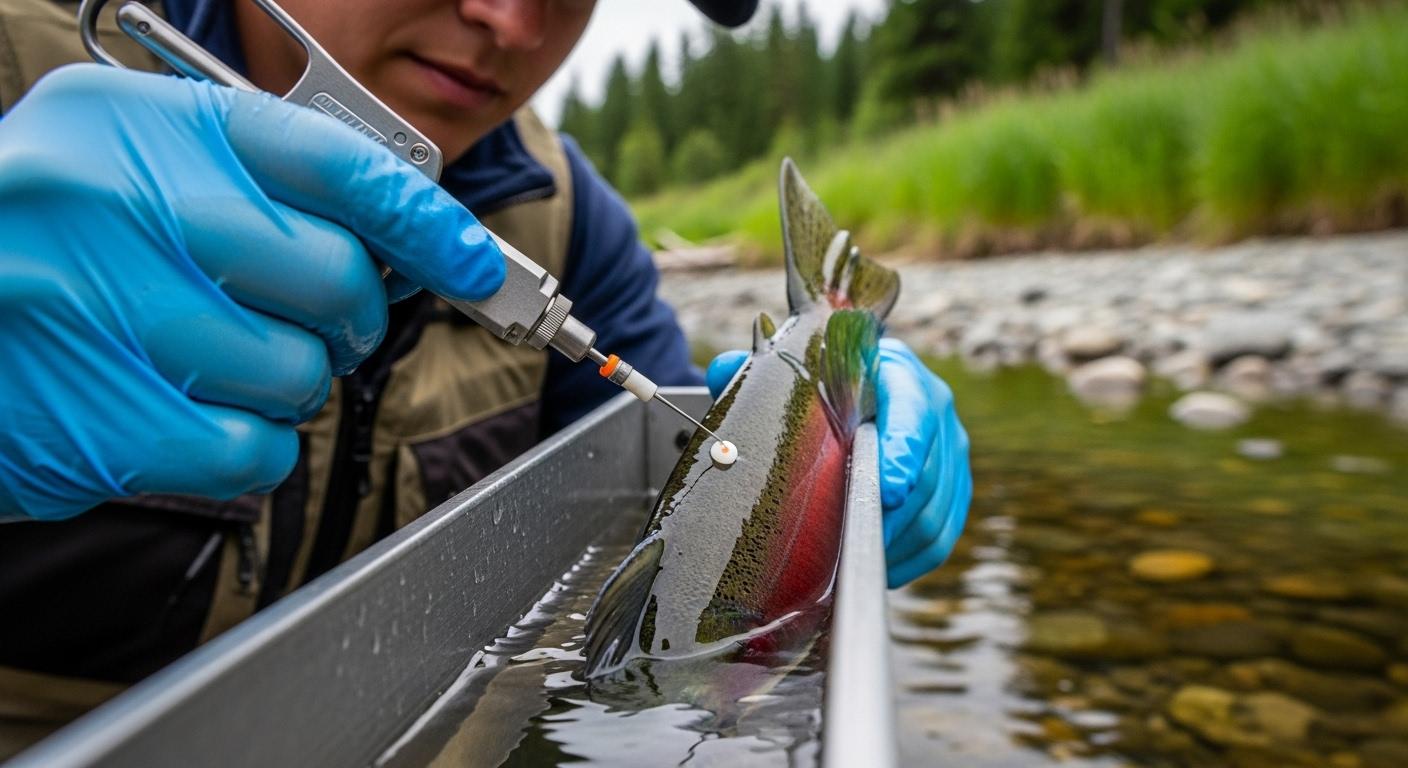
In the world of fisheries research and aquatic conservation, data is the foundation of every major decision. Whether you are tracking salmon migration, assessing population health in a protected lake, or monitoring fish passage at a dam, the technology you choose to identify individuals determines the quality and scope of your findings.
When designing a study, one of the most critical decisions you will face is choosing between passive and active tracking systems. Both fish tags offer unique advantages, and selecting the wrong type can lead to significant budgetary waste, data gaps, or unnecessary stress on your study subjects.
In this guide, we explore the trade-offs between these two fundamental approaches and how to align your equipment choices with your specific research objectives.
Understanding the Difference: Passive vs. Active Tracking
At a high level, the distinction between passive and active systems comes down to how data is transmitted, how much power is required, and the scale of the area you intend to monitor.
Passive Tracking Systems (e.g., PIT Tags)
Passive Integrated Transponder (PIT) tags are the workhorses of long-term ecological monitoring. As the name suggests, these tags are "passive"—they contain no internal battery. Instead, they remain dormant until they pass through an electromagnetic field generated by a reader antenna. When energized, the tag transmits a unique identification code back to the reader.
Because they lack batteries, passive fish tags are remarkably small, lightweight, and have a virtually unlimited lifespan, allowing them to track an individual fish throughout its entire life cycle.
Active Tracking Systems (e.g., Acoustic/Radio Telemetry)
Active systems utilize transmitters—often referred to as acoustic or radio tags—that have their own internal power source. These tags actively emit signals (pings) at programmed intervals. These pings are detected by a series of receivers placed throughout the study environment. Because the tag provides its own power, it can transmit signals over much greater distances (often hundreds of meters) compared to the short-range, "toll-booth" style detection required by passive systems.
Key Factors to Consider When Selecting Your Tags
Choosing the right technology requires a clear-eyed assessment of your project’s logistics. Before investing, evaluate these four pillars of study design.
1. Spatial Coverage and Research Goals
If your goal is to understand general migration corridors or quantify passage through narrow "bottlenecks" like fish ladders, dams, or specific stream junctions, passive tags are generally the gold standard. You can install fixed antenna arrays at these chokepoints to gather precise data on when a specific fish passes a location.
Conversely, if your research focuses on fine-scale habitat use, social interactions, or movement within large, open water bodies where stationary antennas cannot cover the entire area, an active acoustic telemetry system is usually necessary.
2. Fish Size and Biocompatibility
The physical constraints of your study subjects cannot be overstated. A common rule of thumb is that the tag (and any external attachment hardware) should not exceed 2% of the fish's body mass.
Because passive tags require no batteries, they are the smallest options available. They can be injected into fish as small as 45mm, making them ideal for juvenile fish studies. Active tags, by contrast, are heavier due to the battery. While miniaturization technology has improved, active tags often necessitate larger host fish or external attachment methods, which may introduce different behavioral biases.
3. Study Duration and Budget
Budgeting for a study is more than just the cost of the tags; it involves the cost of the infrastructure.
-
Infrastructure Costs: Passive systems require high-density antenna setups at specific locations. Active systems require a network of receivers (hydrophones) that may need to be deployed and maintained over large, potentially difficult-to-access areas.
-
Data Retrieval: Passive systems, when paired with data loggers or cellular modules like those offered by Voda IQ, can provide near-real-time updates. Some active systems require researchers to physically retrieve receivers from the water to download stored data, which can be logistically intensive and costly.
4. Environmental Interference
The environment in which you are working can limit your technology choices. For instance, radio telemetry is often limited to freshwater environments, as signal propagation is severely hindered by the conductivity of saltwater. Acoustic tags, however, perform well in both marine and freshwater settings. Passive PIT tags are largely environment-agnostic, provided you can install an antenna at the detection point.
Conclusion
There is no "one-size-fits-all" solution in fisheries monitoring. Passive tracking systems excel in cost-effective, long-term, and small-fish studies where researchers can focus on specific "gates" or monitoring stations. Active systems provide the spatial granularity required for understanding complex behaviors in expansive, open-water environments.
By carefully evaluating your project’s spatial requirements, the size of your target species, and your long-term research goals, you can select the tagging technology that provides the most robust data for your conservation or management objectives.
Frequently Asked Questions
Q: Can I use both passive and active tags on the same fish?
A: Yes. Many high-stakes research projects employ a "dual-tagging" strategy. By implanting both a PIT tag and an active acoustic transmitter, researchers can get the high-resolution, real-time movement data of the acoustic tag during the initial phase, and the long-term, lifetime individual identification provided by the passive PIT tag.
Q: How do I know if a tag is affecting my fish’s behavior?
A: All tag implantation carries some risk of influencing behavior. Always conduct a pilot study or consult literature on similar species. Ensure the tag is well within the recommended weight-to-body-mass ratio (usually <2%) and that the surgical or injection site is chosen to minimize drag and interference with swimming.
Q: Are there data management tools to simplify PIT tag tracking?
A: Yes, modern data management platforms, including solutions from Voda IQ, are designed to integrate with PIT tag readers to automate the collection, storage, and analysis of detection data, significantly reducing the manual workload for field biologists.

 English
 Arabic
 Spanish
 Portuguese
 Deutsch
 Turkish
 Dutch
Dutch
 Italiano
 Russian
 Romaian
 Portuguese (Brazil)
 Greek
Greek